Overslaan en naar de inhoud gaan

Theory

Induction Heating

Induction heating is a contactless method for heating electrically conductive materials quickly, locally and reproducibly.
Definition

Explanation

What is induction heating?

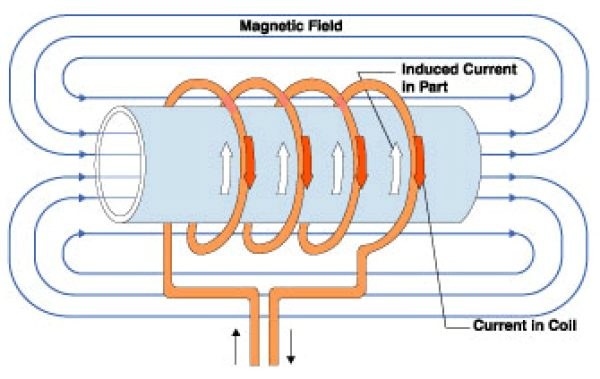
Induction heating generates heat directly inside an electrically conductive workpiece. A copper coil is supplied with high-frequency alternating current, creating an alternating electromagnetic field.
When a metal workpiece is placed in this field, eddy currents are induced in the material. The electrical resistance of the workpiece converts these currents into heat. The component is therefore heated without direct contact with a flame or heating element.
Krimppassen
Shrink fitting
Induction heating Explained
Plaatverwarming
Plate heating

Structure of an induction heating system

A basic installation consists of an induction power supply, cooling system and induction coil. The power supply converts mains voltage into high-frequency alternating current and controls the available power.
The cooling system removes heat from the power supply, capacitors, cables and coil. The coil is matched to the geometry of the product and largely determines where and how uniformly heat is introduced.
Systematics

Frequency, power and penetration depth

Frequency affects the current distribution in the workpiece. At high frequencies, current is concentrated more strongly near the surface. Lower frequencies generally provide a greater penetration depth.
Power, heating time, the distance between coil and workpiece and the properties of the material also determine the final temperature profile.
The correct frequency is selected according to the material, dimensions and required heat distribution.
Principe van inductieverwarming: een wisselend magnetisch veld wekt stroom op in het werkstuk.
Preheating
Applying the Parameters

Characteristics of induction heating

Rapid heating

Heat is generated directly in the material, allowing short heating times.

Targeted heat input

Only the required area needs to be heated.

High repeatability

Power and process time can be controlled accurately.

No open flame

The process does not require a burner or hot combustion gases.

Easy automation

Induction heating can be integrated into production line

Limited distortion

Local and short heating keeps the thermal load under control.
Features

Practical applications

Induction heating is used for hardening, brazing, forging, annealing, shrink fitting, preheating and melting. During hardening, a surface can be heated locally. In shrink fitting, a ring or bearing is expanded temporarily. During brazing, the joint is brought precisely to temperature.

The suitable power supply, frequency and coil geometry vary by application. A thin component requires different process settings from a solid workpiece. The system is therefore matched to the material, dimensions, target temperature and required cycle time.
Shrink fitting
Plate heating
Preheating
Induction brazing
Local heating
Practical applications

Summary

Induction heating uses an alternating electromagnetic field to generate heat directly inside a conductive workpiece. Frequency, power, heating time and coil geometry determine the heat pattern and penetration depth.
Summary