Overslaan en naar de inhoud gaan

Theory

Penetration Depth and Skin Effect

With alternating current, current density is highest near the surface of a conductor. This effect largely determines where heat is generated during induction heating.
Definition

Explanation

What is skin effect?

Skin effect is the tendency of alternating current to concentrate near the surface of a conductor. Its strength increases with frequency, making it particularly important at high-frequency and radio-frequency currents.
Effect of frequency
At low frequency, current penetrates relatively deeply into the material. As frequency rises, the effective current-carrying layer becomes thinner. As an indication, skin depth is about 1 cm at 50 Hz, less than 1 mm at 10 kHz and only a few tens of micrometres at 10 MHz. At very high frequencies, current therefore flows almost entirely near the surface.
Because a smaller part of the conductor cross-section carries current at higher frequencies, the effective electrical resistance increases.
Skin effect during induction heating of a steel gear
Surface heating of a gear
Skin effect Explained
Local induction heating of steel cylinder showing skin effect
Local surface heating of a cylindrical workpiece

Use of skin effect in induction heating

Unlike many electrical applications where the skin effect is considered a disadvantage, induction heating takes advantage of this phenomenon. At higher frequencies, induced eddy currents are concentrated near the surface of the workpiece, where electrical resistance converts energy into heat. This controlled surface heating is widely applied in induction hardening and other heat treatment processes.
Use in induction heating

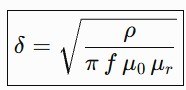
Formula for skin depth

Skin depth δ can be calculated from frequency, magnetic permeability and the electrical conductivity of the material.
Skin depth formula for induction heating and electromagnetic penetration depth
Formula and symbols used to calculate skin depth.

δ

skin depth in metres

f

frequency of the magnetic field in hertz

μ

magnetic permeability of the material in henries per metre

σ

electrical conductivity of the material in siemens per metre
Calculating skin depth

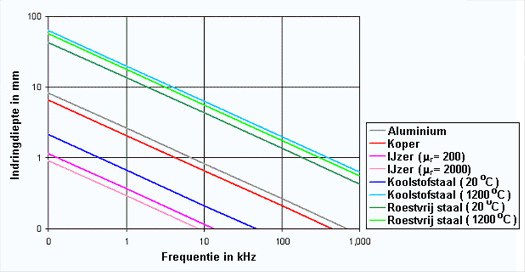
Skin depth for different metals

The graph shows indicative values at room temperature. Actual skin depth depends on the material, alloy, temperature and magnetic state.
Indicative skin depth as a function of frequency for different metals.
Skin effect per Metal Type

Summary

A higher frequency produces a smaller skin depth and a stronger concentration of current near the surface. In induction heating, this principle determines the heat distribution and enables rapid, local surface heating.
Summary
Induction heating of large steel ring showing penetration depth
Induction heating of a large ring
Local induction heating of steel cylinder showing skin effect
Local surface heating of a cylindrical workpiece
Skin effect during induction heating of a steel gear
Surface heating of a gear